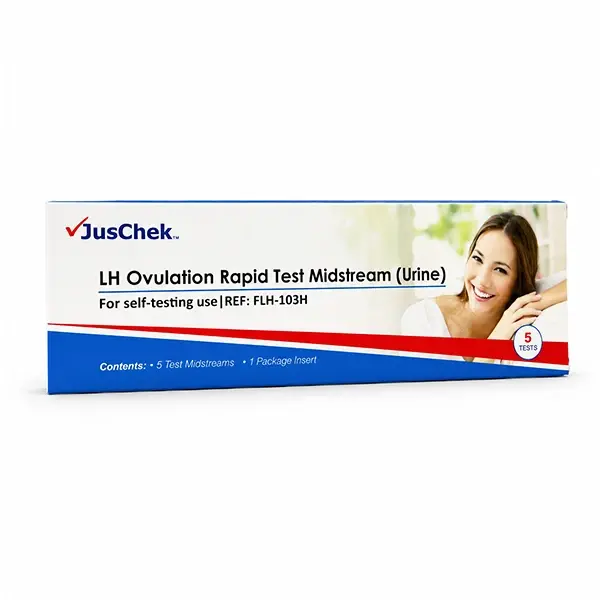
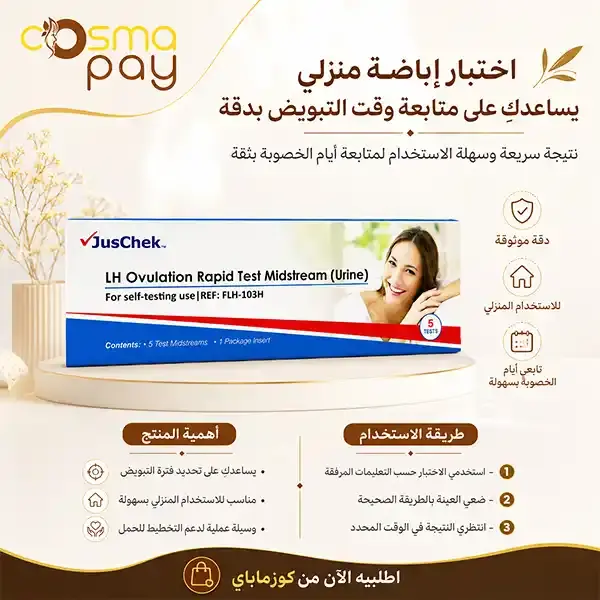
Trying to work out your ovulation days using dates and calculations alone can be confusing, especially when your menstrual cycle changes from one month to another. This uncertainty may make it harder to identify your most fertile days and can add unnecessary stress while trying to conceive.The Juschek Ovulation Kit helps detect the rise of luteinizing hormone, or LH, in urine before ovulation. This allows you to identify the time when your chance...
Trying to work out your ovulation days using dates and calculations alone can be confusing, especially when your menstrual cycle changes from one month to another. This uncertainty may make it harder to identify your most fertile days and can add unnecessary stress while trying to conceive.
The Juschek Ovulation Kit helps detect the rise of luteinizing hormone, or LH, in urine before ovulation. This allows you to identify the time when your chances of conception may be higher, using a simple home test that provides an easy-to-read result within minutes.
How Does the Juschek Ovulation Test Work?
The Test is a rapid home ovulation test that analyses a urine sample to detect a sudden rise in luteinizing hormone.
During each menstrual cycle, the level of LH usually increases shortly before the ovary releases an egg. This rise is commonly known as the LH surge.
Ovulation often occurs approximately 24 to 36 hours after the LH surge begins. By detecting this hormonal increase, the test can help you identify the days when you are likely to be most fertile.
However, the test detects the hormonal surge rather than confirming that an egg has actually been released.
Benefits of the Juschek Ovulation Kit
The Ovulation Test offers several practical benefits for women who are tracking their fertile window:
Helps identify the most fertile days of the menstrual cycle.
Provides results within minutes.
Easy to use privately at home.
Supports more informed pregnancy planning.
Requires no additional equipment.
Can be used during regular or relatively predictable menstrual cycles.
Helps reduce reliance on calendar calculations alone.
When Should You Start Using the Juschek Ovulation Test?
The best day to begin testing depends on the usual length of your menstrual cycle.
The first day of menstrual bleeding is counted as day one of your cycle.
For example, women with a regular 28-day menstrual cycle are often advised to begin testing around day 11. Testing should then continue once a day until an LH surge is detected.
If your cycle is irregular, you may need to use the length of your shortest recent cycle to estimate when to begin testing. Because irregular cycles can make ovulation more difficult to predict, consulting a doctor may be helpful if your cycle varies significantly from month to month.
Always check the testing schedule included in the product leaflet, as instructions may vary.
What Is the Best Time to Take an Ovulation Test?
To improve the consistency of your results, try to take the test at approximately the same time every day.
For many women, the preferred testing period is between 10 a.m. and 8 p.m., with late morning or afternoon often being suitable.
For a clearer result:
Avoid drinking large amounts of water for around two hours before testing.
Try not to urinate for approximately two hours before collecting the sample.
Test at a similar time each day.
Follow the timing instructions provided with the product.
Drinking excessive fluids may dilute the urine and make the LH surge more difficult to detect.
How to Use the Juschek Ovulation Kit
Follow these general steps unless the instructions on the product packaging state otherwise:
Collect a urine sample in a clean, dry container.
Remove the test strip from its packaging.
Dip the absorbent end into the urine up to the marked line.
Keep the strip in the sample for approximately 10 to 15 seconds, or for the period stated in the leaflet.
Remove the strip and place it on a clean, flat surface.
Wait for the recommended development time.
Read the result within the time specified in the instructions.
Do not immerse the strip above the maximum line, and do not interpret the result after the recommended reading period has passed.
How to Read the Juschek Ovulation Test Result
Positive Ovulation Test Result
The result is generally considered positive when the test line is the same colour as or darker than the control line.
This indicates that an LH surge has been detected. Ovulation may occur within the following 24 to 36 hours, making the day of the positive result and the following day part of the likely fertile window.
A positive result does not confirm pregnancy and does not guarantee that conception will occur.
Negative Ovulation Test Result
The result is generally considered negative when:
The test line is lighter than the control line.
The test line does not appear while the control line is visible.
This means that an LH surge has not been detected at the time of testing. Continue testing on the following day at approximately the same time.
A faint test line is not necessarily a positive result. The test line usually needs to be as dark as or darker than the control line.
Invalid Test Result
The result may be invalid if the control line does not appear.
In this case, the test may not have worked correctly. Repeat the test using a new strip and carefully follow the instructions provided.
Tips for Getting a Clearer Result
For more consistent ovulation tracking:
Perform the test at approximately the same time every day.
Avoid excessive fluid intake before testing.
Record the result each day.
Compare the colour intensity of the test line over several days.
Use a timer instead of estimating the reading time.
Begin testing before your expected ovulation date.
Store the tests according to the package instructions.
Check the expiry date before use.
Tracking your cycle dates alongside the test results may also help you recognise your personal ovulation pattern over time.
Common Mistakes When Using an Ovulation Test
Certain mistakes can make the result more difficult to interpret, including:
Testing at a different time every day.
Drinking too much water before collecting the sample.
Reading the result too early or too late.
Dipping the strip above the marked line.
Assuming that any visible second line means a positive result.
Missing a testing day during the expected fertile window.
Using an expired or incorrectly stored test.
Remember that a positive result normally requires the test line to be as dark as or darker than the control line.
Limitations of the Just Check Ovulation Test
Although the Just Check Ovulation Test can be a useful fertility-tracking tool, it has some limitations:
It detects an LH surge but does not directly confirm that ovulation has occurred.
Hormonal conditions may affect the result.
Women with polycystic ovary syndrome may experience repeated or persistently elevated LH levels.
Some medicines, particularly fertility treatments containing hormones, may affect test results.
Very irregular menstrual cycles can make it difficult to determine the correct testing day.
The test does not diagnose fertility problems.
A positive ovulation result does not guarantee pregnancy.
Speak with a healthcare professional if you repeatedly receive unclear results, never detect an LH surge, or have concerns about your menstrual cycle or fertility.
Why Choose the Juschek Ovulation Kit?
The Ovulation Test offers a simple and convenient way to monitor your fertile window from home. Instead of depending entirely on calendar calculations, you can track the hormonal change that often happens shortly before ovulation.
With regular testing, correct timing, and careful use, the test may help you plan intercourse around the days when conception is more likely.
For best results, follow the product instructions carefully and seek medical advice if your results remain unclear or pregnancy is delayed.